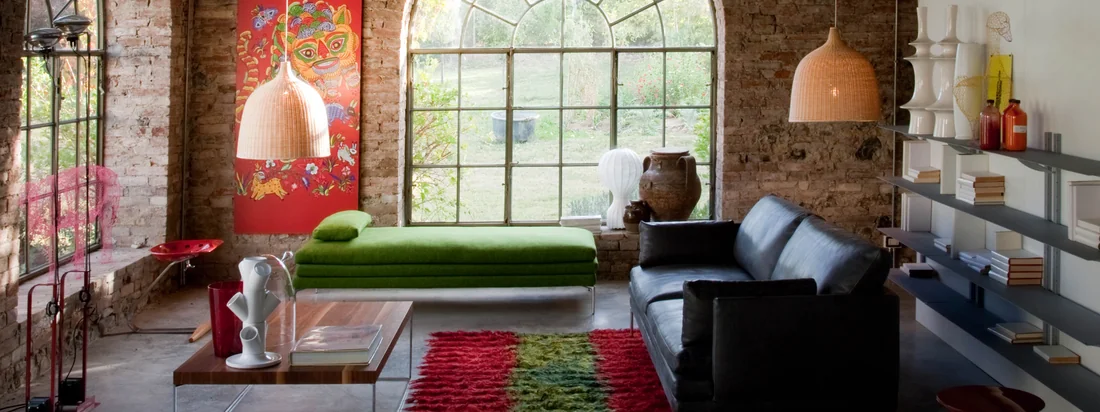
Italian Design Furniture: Fusion of Elegance and Tradition
Since the end of the Second World War, Italy has become the design nation par excellence. The names Alessi, Brionvega, Danese Milano, Gufram or Zanotta are today synonymous with Italian product and furniture design.
In contrast to Germany and other European nations, industrialization had begun very late in Italy. In many sectors the transition from manual to industrial production took place only shortly after the war. Whereas in Germany design trends had already developed in the 1920s, design in Italy slowly started to become important in the late 1940s.
- Experimental Design - the Italian Line
- 1960s / 1970s: A New Culture of Design
- 1980s & 1990s Design Synonymous with Lifestyle
- Popular Italian Designs
Experimental Design: the Italian Line
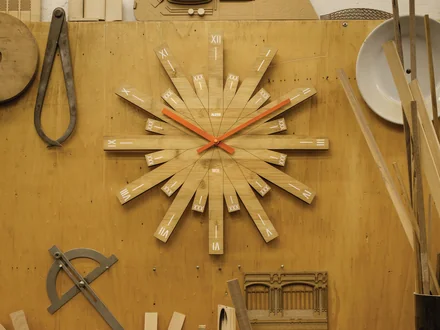 Exhibitions such as the "Triennial" in Milan (since 1933), competitions and magazines played an important role in the development of Italian Design. In addition to that, it was above all the Compasso d'Oro, the "Golden Circle" awarded by the Milan department store chain La Rinascente since 1954, and the two magazines Domus (founded in 1928 by Gio Ponti) and Casabella (1929), which promoted modern Italian design furniture.
Unlike the theoretical approach of the Bauhaus school in Germany or the marketing- and profit-oriented design concept in the USA, the Italian design lived above all on its experimentation, the improvisational ability of small craft enterprises and the old cultural tradition, which was hardly able to separate beauty and function from each other.
It was precisely the smaller craft enterprises, craftsmen's workshops and family businesses that, in collaboration with architects and through their dynamic and individual forms, created new designs. The "Italian Line", around 1955, became internationally the epitome of modern, sophisticated and cosmopolitan lifestyle.
1960s / 1970s: A New Culture of Design
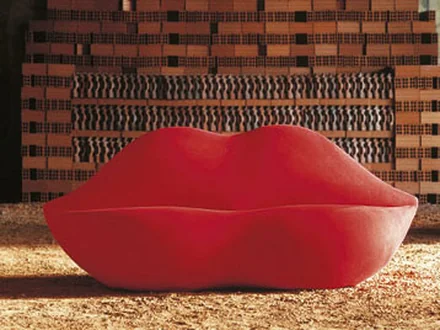 In the 1960s, Italy also enjoyed a period of prosperity and mass consumption. Furthermore, new technologies and materials, such as the processing of plastics, gave new impetus to the shaping of products. Companies such as Olivetti or Kartell benefited from these innovations and made Italy a pioneer of new developments in design: this was impressively demonstrated by the exhibition "The Domestic Landscape", which was on display at the Museum of Modern Art in New York in 1972. The exhibition showed mainstream and anti-design, elegance and experimentation, classics and provocations, epitomizing the tolerance and openness that characterizes Italian design furniture to this day.
The exhibition reflected the entire contradictions of the situation Italian design was in at the time. On the one hand, it showed furnishings representing the Bel Design and conventional industrial production. On the other hand, experimental and futuristic objects emerged from a subversive design culture. In the mid-60s, there was hardly one single Italian design.
 Not least because of workers' protests and student riots, groups of northern Italy's art schools have emerged that favored utopian designs and theories and rejected mainstream. Their main criticism was the aestheticization of industrially manufactured products and the cycle of production and consumption in capitalism. This resulted in the movement of Radical Design, which had the goal to transform society with design and architecture. The young designers, contrary to the older generation, who established the "Bel Design", understood the industrial design as a dead end.
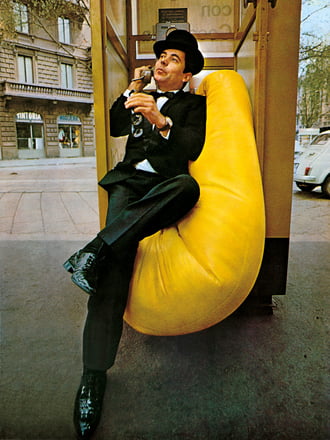
An Italian phenomenon at the end of the 1960s was that the gap between industrial production and experimental counter-designs was unifying in some designers and entrepreneurs. By 1970 brave and adventurous entrepreneurs emerged, who secured some designs from the young rebels. This is how the classics of Italian design furniture were created. Among them are designs such as the Sacco bean bag by Zanotta (1968) or the shrill coat rack Cactus by Gufram (1971). With the opening of the industry for the new Italian design culture, the rebellion of the young designers' thunder was stolen.
All the more surprising that in the mid-1970s, a second wave of Radical Design came up, which was embodied by the groups Alchimia (founded in 1976) and Memphis (founded in 1981). With the unconventional group of Memphis, to which e.g. Michele De Lucchi, Matteo Thun or Ettore Sottsass belonged, not only the Italian design culture experienced a revolution. Every year, Memphis released a new collection. The focus of the movement were the design of the surfaces and colorful playfulness, multi-purpose instead of monofunctionality and the communicative aspect of design products.
1980s / 1990s - Design Synonymous with Lifestyle
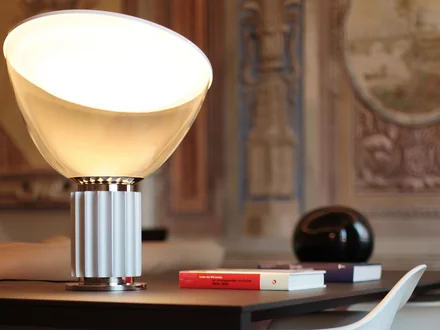 In the mid-80s, with the second generation of Memphis, the movement slowly became a mere fashion. However, during its heyday, the group created a new form of experimentation that led to the creation of new companies and gave new inspiration to traditional ones. Design brands such as Artemide, Driade or Zanotta employed Memphis designers and Alessi, led by Alessandro Mendini (Alchimia), broke new ground with architects such as Aldo Rossi and Stefano Giovannoni.
In the 1980s, due to the economic boom, a new form of advertising, image building, and personality cult developed. Design was synonymous with lifestyle and an important marketing tool. The names of companies and designers have become increasingly important in the context of corporate identity programs. Likewise, in accordance with the fashion world, the term "collection" was introduced.
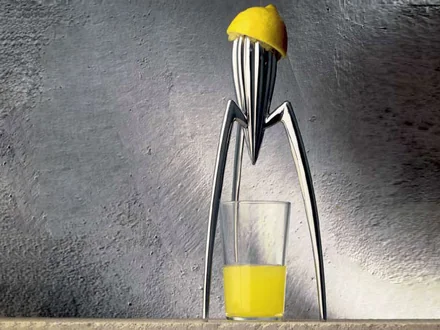 This changed in the economically more uncertain times of the 1990s, when the cult of the spectacular object largely exhausted. Italian design became more modest and many manufacturers came up with solid, elegant and reputable designs. Already initiated by the Memphis movement, especially the cooperation with international designers was intensified. Italian companies such as Alessi, Driade, Moroso or Flos have since then worked closely with renowned international designers such as Jasper Morrison, Philippe Starck or Ron Arad, making many of today's objects hardly typically Italian, but still or perhaps because of that successfully established products in the global market.
 Alessi
 Artemide
 B-Line
 Danese Milano
 Driade
 Flos
Flos
 Foscarini
 Kartell
 Lapalma
 Magis
Magis
 Plank
Plank
 Zanotta
 Emu
Emu
 Fiam
Fiam
 Luceplan
 Oluce
Oluce
 Alessandro Mendini
 Enzo Mari
 Gianfranco Frattini
 Michele De Lucchi