

Wilkhahn – a successful union
In 1907, Friedrich Hahne and Christian Wilkening founded a chair-making factory in Eimbeckhausen near Hanover. The name of the two founders was later used to create the company name of Wilk-hahn. High-quality, solid beech chairs were made from wood from nearby forests.
Fritz Hahne and Adolf Wilkening took over their fathers' chair factory in 1946. They looked for new design paths and took up contact with Walter Heyn, the director of Deutsche Werkstätten, and with designers such as Georg Leowald and Herbert Hirche whose work was influenced by the Bauhaus movement and the Werkbund. At that time no one sensed that their fascination with experimentation would later pay off. The secret of the advance from a craft business to a company with international operations was simple: success through design.
Wilkhahn design – social responsibility meets mass consumption
In 1965, truly revolutionary products were developed in close collaboration with the Ulmer Hochschule für Gestaltung (Ulm Academy of Design). The avant-gardists of industrial design pushed the limits of the political dimensions of design. Consumerism and the “ad libitum" attitude to design was contrasted with the social responsibility of designers and the "morality of things." Wilkhahn adopted one of the maxims from the founding manifesto of the Ulm designers as he proclaimed that “our aim is to develop sustainable products, to increase their utility value and to reduce waste."
In 1980, Klaus Frank and Werner Sauer developed a new office swivel chair following intensive ergonomic studies and series of tests. The FS-Line marked the consistent implementation of the principle of dynamic sitting long before its great significance had come to be realised.
In 1985, the wiege Entwicklungsgesellschaft mbH independent design office was founded as a spin-off of the development deparment of Wilkhahn. Nowadays, wiege in an international design company that works for clients from different sectors in addition to its work for Wilkhahn.
In 2002, Wilkhahn received the German Federal Product Design Award for the table series DinA by Udo Schill and Timo Küchler.
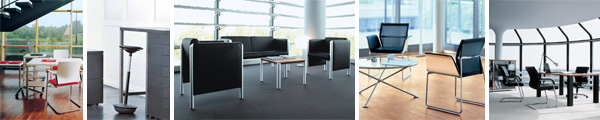
The Wilkhahn brand is characterised by its unique combination of design, innovation and quality. At Wilkhahn, shapes are created beyond fast-lived trends and instead reduced to the essentials – honest, self-evident and excitingly beautiful despite its functionality. It comprises self-explanatory and intuitive usability just as much as a pleasure for good form, authentic materials and carefully crafted details. The strength of Wilkhahn design lies In its restraint. Its products are appealing without dominating the room or pushing for attention.
Website by Wilkhahn