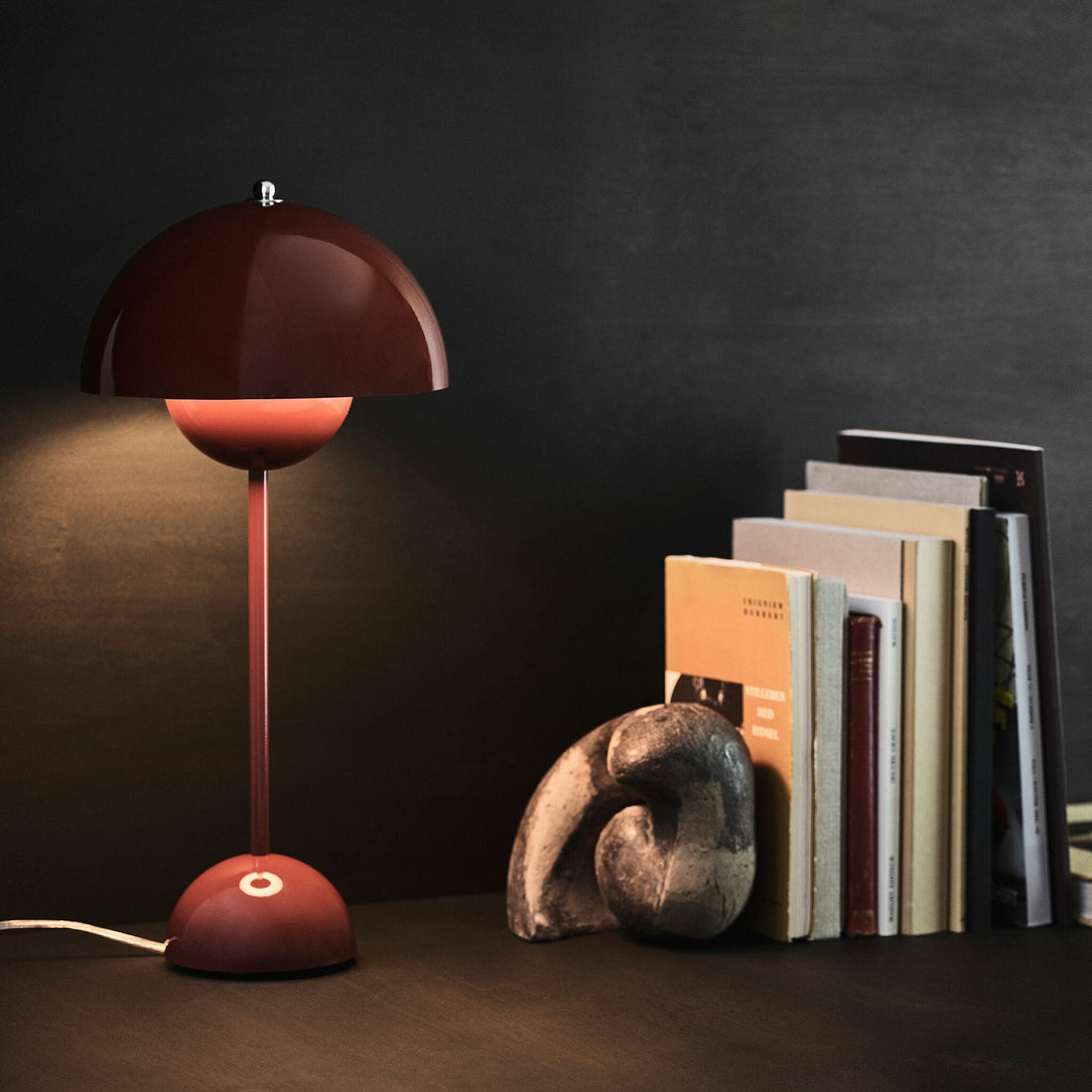
The right desk lighting helps you work better. And that's not all: light intensity and colour affect not only your motivation and productivity, but also how much you enjoy working or studying. Here we show you how to light your desk properly and which lamps offer useful extra features.
What to look for when lighting your desk:
- Three components
- The right brightness
- The right light colour
- The right lamp for your desk
- Desk lamps with practical features
- LED desk lighting
In a hurry? Go straight to the desk lighting summary.
1. Three components of ideal desk lighting
Ideal lighting for your workspace is made up of three components:
- daylight,
- indirect workspace lighting and
- a flexible desk lamp.

Daylight for more motivation and better performance
As a general rule, daylight is the best light for focused, effective work. Its qualities motivate and stimulate us. The reason is our biorhythm, which is largely guided by the way light changes over the course of the day.
So place your desk as close to the window as possible. Dark or even windowless rooms are less suitable for a home office, as you would have to rely too heavily on artificial light sources to light your desk.

Position your desk side-on to the incoming light. Especially when you're working on a computer or laptop, light from behind would cause glare on the screen or cast shadows. Light from the front would dazzle you.
Because daylight changes with the time of day, the season and the weather, it's a good idea to fit glare protection at the window. This protects you from overly strong, direct sunlight.
Indirect lighting for basic brightness
Add indirect desk lighting to complement the daylight. It isn't aimed directly at your desk, but provides a basic level of brightness in the room. This could be a ceiling light, a pendant light with a shade or wall lights.

Depending on how much light you need and the size of the room, you can add further glare-free light sources to the general lighting in your study. A floor lamp works well, as do wall lights.
Several light sources in the room distribute the light as evenly as possible, which helps you concentrate.
A flexible desk lamp for targeted light
A desk lamp lets you adapt the lighting to your needs and to whatever you're doing at the moment. So it should be as adjustable as possible.

It's important that the direct light comes from the side, so that it doesn't cause glare on the screen or dazzle you.
2. The right brightness for your workspace
The light output of a lamp is measured in lumens and is a good indicator of the right brightness. The lumen is the unit of luminous flux.
To work out the ideal brightness for your desk lighting, it's not only where and how the light is used that matters. The size of the room is also very important. That's why all recommendations are given in lumens per square metre. This way, you can calculate the lumen values based on the floor area of your room.

High light intensity combined with a high colour temperature helps you concentrate. You'll find out more about colour temperature in the next section.
3. The right light colour for your desk lighting
In the past, cool white light was the standard choice, but feeling comfortable while you work is becoming increasingly important.
Today, interior designers usually choose neutral white (approx. 4,000 kelvin) or warm white (approx. 3,000 kelvin) for a study. With sufficient brightness, both allow you to concentrate without compromising your comfort.

Alternatively, choose artificial daylight (approx. 6,000 kelvin). It imitates sunlight and makes us feel more alert and energetic, especially in winter.
Tip: "Just as in a professional office, customers should make sure at home that the light is distributed fairly evenly across the desk. Too many contrasts or different light colours strain the eyes unnecessarily." – Kasper Ipenburg, lighting expert at HAY.
4. The right lamp for your desk
Different desk lamps suit different desks and working situations.
Children's desk: Clamp lamps can't be knocked over. They also take up little space, leaving your children's desk – which is usually quite small anyway – free for studying and drawing. A separate clamp is available for some classic table lamps.
Secretary desk or small workspace: Like a clamp lamp, a floor lamp takes up no space on the desk. If the lamp is also dimmable, it can serve as indirect lighting and a decorative light source once your work is done. Practical if your secretary desk is in the living area.

Classic desk: If your desk is only used for work, a classic desk lamp will meet all your needs.
Multifunctional table: If your table is used for different activities, a flexible desk lamp with a swivel arm, a pendant light with a shade or a table lamp with extra features are good options. You can read more about this in the next section.

5. Desk lamps with practical features
Modern desk lamps are not only bright and flexible. Designers are keeping pace with social and technological developments and adding practical features to their lamps.
Some lamps come with storage space – like the Buddy table lamp by Northern. A pot for pens and other bits and pieces forms the base and gives the lamp stability.

Cables integrated into the base or arm of the lamp make it easy to fit your desk lamp discreetly into your living space. Practical if your workspace is in the living area.
6. Save money in the long run with LED desk lighting
Especially if you spend several hours or more at your desk at home, the energy consumption and cost of generous lighting shouldn't be underestimated.
LEDs are environmentally friendly. Despite their high luminous efficacy, they save energy and therefore money: you can save up to 85 per cent on electricity costs. And you have a wide choice: LED bulbs are available in a broad range of light colours and intensities.

LED technology also allows lighting manufacturers to create completely new, original designs. The Italian company Flos is a leader in innovative lighting solutions. It brings iconic lamps such as the well-known banker's lamp into the present day with modern LED technology, and uses the small size of LEDs to create new, slim designs.
By distributing the light sources cleverly, Flos creates the even, soft and glare-free light you need for working and studying.
Thanks to innovative technology, the manufacturer's design options are now almost limitless. The selection is correspondingly varied: understated, iconic or futuristic. As most of them are dimmable, you can easily adapt the light of many lamps to what you're doing.
Important: LEDs in particular are very sensitive and react even to small changes in voltage. So make sure the light doesn't flicker.
Desk lighting at a glance:
Make sure you have
- sufficient brightness,
- even light distribution from several light sources,
- minimal shadows thanks to the correct position of your desk,
- no glare, for example by using glare protection,
- a light colour that helps you concentrate but still feels pleasant and
- energy-saving, cost-efficient light sources such as LEDs.
Practical features such as charging options, storage space and more also turn your desk lamp into a multifunctional light source.
To find out what else to consider for a comfortable workspace – whether in a dedicated study or in your living room or bedroom – and how to make it look inviting, read our article on the home office.