When you think of Scandinavian design, you probably picture light wood, subtle cream tones and an almost meditative calm. And then there's Verner Panton – the bright, curvy and gloriously unconventional exception to the rule.
In 2026, we're celebrating Verner Panton's 100th birthday. But while other design classics from that era often feel like museum pieces, Panton's designs feel as if they've come straight from the future. Why is that? Why, in a world full of smart homes and minimalism, are we reaching for the Panton Chair or the Panthella again?

The rebel with the paint gun: a short portrait
Who was Verner Panton? The Danish architect and designer Verner Panton (1926–1998) had little time for compromise. While contemporaries such as Arne Jacobsen were still perfecting plywood, Panton was already dreaming of fluid forms and psychological colour spaces.
Verner Panton's philosophy in three words:
1. Courage: he wasn't afraid of failure (and often failed before technology could catch up with his visions).
2. Colour: for Panton, colour wasn't a decorative extra but a tool for guiding emotions.
3. Space: he didn't think in terms of individual pieces of furniture, but in atmospheres – objects as part of a dynamic living environment.
"The main purpose of my work is to provoke people into using their imagination. Most people spend their lives living in dreary, grey-beige conformity, mortally afraid of using colours." – Verner Panton
What made Verner Panton a revolutionary: plastic and the liberation of form
Panton was the first to understand the new freedom that industrial production offered. He broke with the traditional four-legged chair.

A single material: the legendary Panton Chair was the first cantilever chair made from a single piece of moulded plastic. It was a Herculean technical task that took years of development with Vitra. And it proved that a piece of furniture can look like a sculpture and still be stackable and comfortable.
Colour as architecture: Panton designed entire interiors (think of the famous Spiegel publishing building in Hamburg) in which the floor, walls and ceiling merged into one. He used colour to create a sense of security or energy – a forerunner of today's "dopamine decor".
Why Panton is more relevant than ever in 2026
Why are his designs making such a huge comeback right now? To be honest, we've grown a little tired of "safe design".
1. The longing for individuality
At a time when Instagram feeds often look all the same, a Panton design makes a statement. It says: "I dare." A Panton Wire shelf or a VP Globe pendant light isn't just a piece of furniture – it's a character in the room.

2. Statement pieces instead of throwaway products
We're consuming more consciously. Instead of buying five short-lived trends, we invest in the one object that defines the room. Panton's designs have that rare quality: they're visually loud, but so thoroughly thought out in form that you never tire of them.
3. Emotional ergonomics
We live in a digital, often cool world. Panton's organic forms – soft curves that mimic the human body – offer a tactile and visual contrast to the hard edges of our screens. His designs help us slow down.

4. The contribution of our heritage brands
Without questioning Verner Panton's design genius: the fact that his designs are more popular today than during his lifetime is also thanks to brands such as Vitra, Verpan, Louis Poulsen, &Tradition and Montana. They have turned a "child of its time" – the cheerful 1960s and 70s – into a timeless global brand. This success is based above all on the way these manufacturers have consistently developed production technology and carefully adapted the original designs to modern lifestyles.
"We have expanded the Panton portfolio with options that show the classics in a new, contemporary light while preserving their iconic value." – Christian Grosen, Chief Design Officer at Vitra
Thanks to new, durable materials and modern production methods, Panton's designs are more durable than ever today. The Panton Chair is a prominent example: in the 1970s, production had to be stopped completely for a time because the materials used back then – such as glass-fibre-reinforced polyester or unstable polystyrene – became brittle and broke under stress. It was only the innovative plastics of the 1990s that turned the sculpture into the robust everyday object we know today.

Most of the designs are also more sustainable than ever: a focus on recyclability and circular material cycles is making the classics fit for the future.
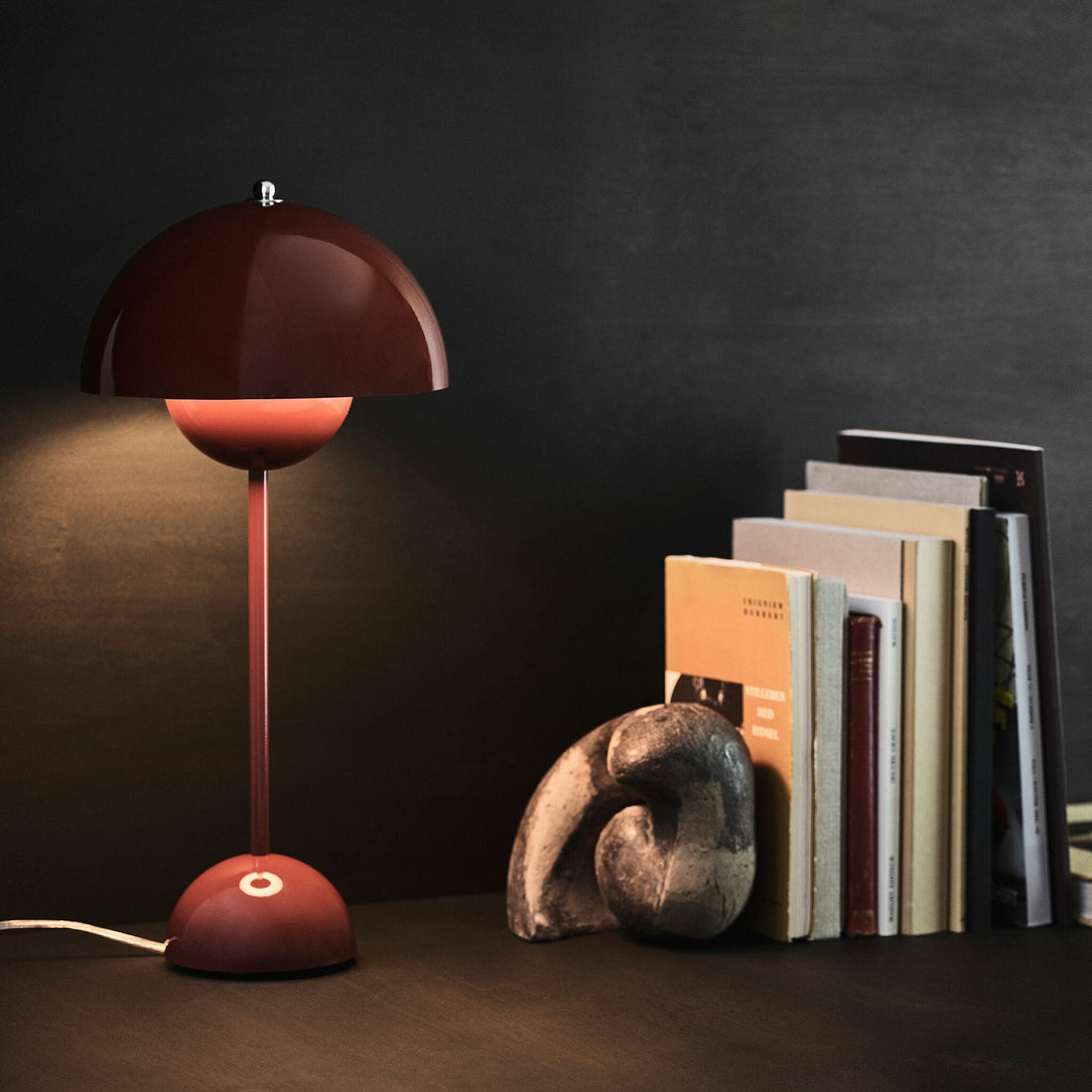
At the same time, they are more flexible than ever: with the Panton Wire system, Montana offers endless configuration options for modern living. Vitra now makes the classic Panton Chair from durable, UV-resistant polypropylene, which makes it not only more affordable but also suitable for outdoor use. And thanks to the latest rechargeable LED technology, &Tradition has transformed the iconic Flowerpot into a cordless, portable lamp – a sought-after lifestyle accessory for indoors and outdoors.

Finally, these heritage brands are masters at telling the stories behind the designs. We love products that didn't start out as "perfect" industrial goods, but have developed over more than 50 years from a fragile experiment into a sustainable all-rounder.
Thank you for 100 years of optimism and joie de vivre!
Celebrating Verner Panton doesn't mean looking back nostalgically to the 1960s. It means adopting his spirit of freedom. A home with a Panton design in it always has a little more optimism.
The iconic Flowerpot lamp on the bedside table or the bold Panton Pop on the terrace: Panton reminds us that design is allowed to be fun – and that it should challenge us. 100 years on, one thing is clear: he wasn't just a designer, he was a visionary of joie de vivre.
Happy 100th birthday, Verner Panton!

Learn more about Verner Panton, the man and the designer – FAQ
Who was Verner Panton?
Verner Panton (1926–1998) was one of the most influential Danish designers of the 20th century. While his contemporaries focused on wood and functionalism, he became world famous for his futuristic plastic designs, his love of bold colours and his visionary room installations.
How did Verner Panton's career begin?
Panton studied architecture at the Royal Danish Academy of Fine Arts in Copenhagen. He gained decisive experience in the early 1950s at the studio of design icon Arne Jacobsen, where he worked on the legendary Ant chair, among other things. But it soon became clear that Panton wanted to leave the traditional paths of Scandinavian craftsmanship and explore the possibilities of new materials.
What was the most radical break in his development?
Turning away from wood was Verner Panton's most radical break. While Denmark was famous for excellent joinery, Panton saw the future in steel, plastic and fibreglass. In 1955, he founded his own studio, and in 1958 he shocked the design world with the Cone Chair: an armchair in the shape of a cone, balanced on its tip. It challenged visual expectations of how a piece of furniture "should" stand.

What is Verner Panton's best-known design?
The Panton Chair (1967). It was the world's first cantilever chair made from a single piece of plastic. With its S-shaped silhouette, it is regarded as one of the most important icons of modern furniture design and can be found today in the world's leading museums, such as MoMA in New York.

Why are his designs so popular again today?
In an era of minimalist "quiet luxury", Panton's designs offer a much-needed counterbalance: individuality and optimism. His objects act as statement pieces that bring character to clean-lined rooms. His focus on organic forms also matches the current zeitgeist. And thanks to technological development and modern materials, his designs are more durable, sustainable and flexible than ever.
Why did Panton work so much with plastic?
Panton was fascinated by the possibilities of industrial mass production. Plastic allowed him to create shapes (such as curves and waves) that would have been impossible in wood. He wanted to democratise design – high-quality design should be accessible to many people, not just an elite.
Is Panton furniture comfortable despite its shape?
Yes, absolutely. Panton was a master of the ergonomic curve. The Panton Chair, for example, adapts surprisingly well to the body thanks to the flexibility of the material and its anatomical shape. His designs follow the philosophy that sitting should be an experience.