Alessandro Mendini – a co-founder of Redesign
Born in Milan, Italy, in 1931, Alessandro Mendini played a central role in the development of Italian design.
In 1960, just a year after completing his architecture degree in Milan, Mendini became a partner of Olivetti designer Marcello Nizzoli at "Studio Nizzoli Associati".
Mendini became a theorist of Italian avant-garde design and a driver of new trends through his work as founder, publisher and editor-in-chief of the magazines "Casabella" (1970–1976), "Modo" (founded 1977) and "Domus" (1979–1985).
In 1973, Mendini co-founded the alternative design school "Global Tools", and in 1978 he became one of the first members of the legendary Studio Alchimia, for which he created the Kandissi sofa and the Ondoso table (both 1979).
Together with other Italian designers, Mendini developed the concepts of Redesign and Banal Design, in which everyday objects are transformed into new, ironic objects through colour and form. His ironic, often even irreverent approach to conventional ideas of "good taste" and his reworking of historical masters and design classics frequently sparked lively debate.
"Originality no longer exists today. The invention of new forms is being replaced by variations in decoration and surface. Design is redesign. Designing is decorating."
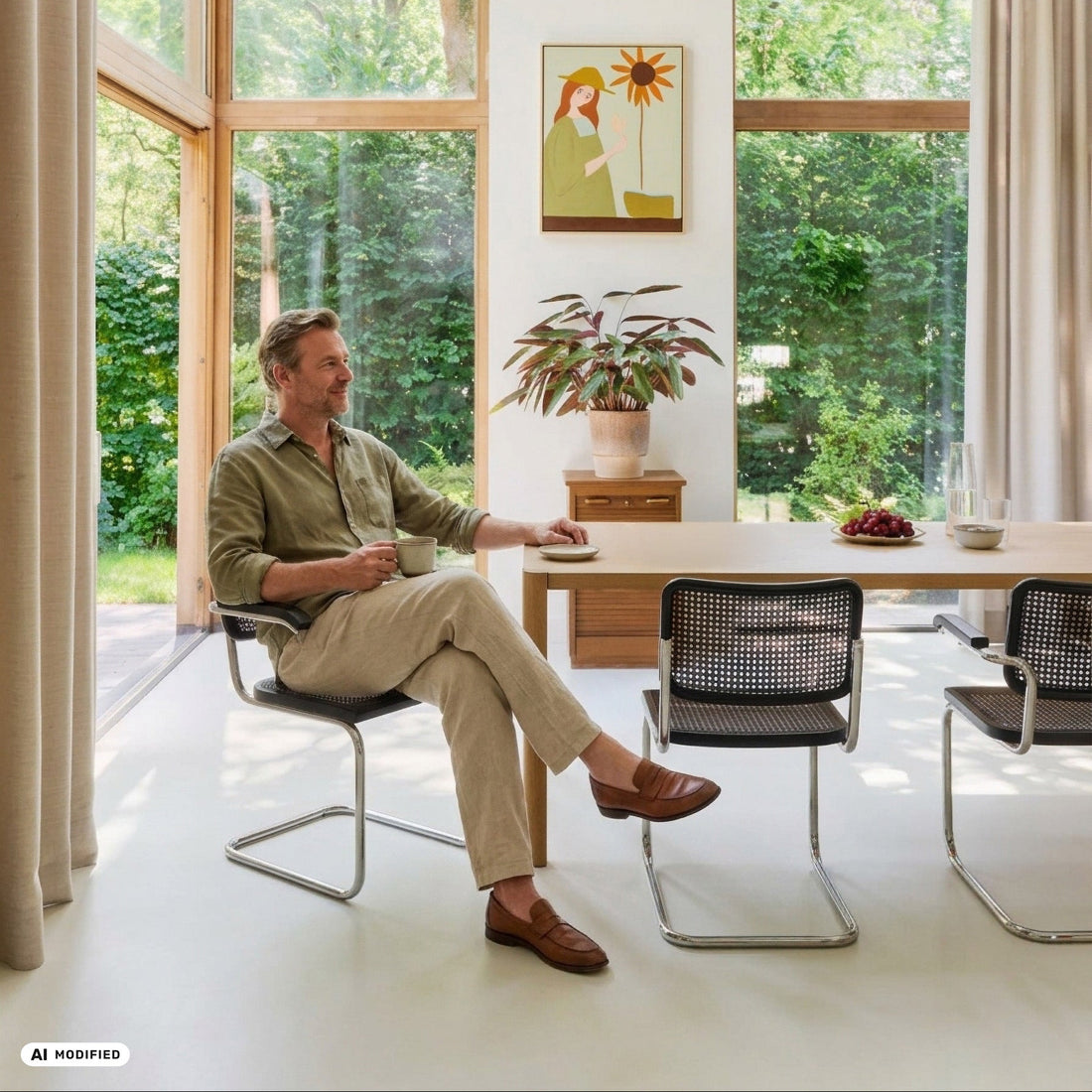
Objects embellished – and thus transformed – with decoration and ornament, as he demonstrated on Thonet and Bauhaus chairs, met with incomprehension and harsh criticism, especially from advocates of functionalism. But Mendini's aim was precisely not to represent a one-dimensional or functional design style. He wanted to raise questions about the meaning and purpose of design and so encourage conversation about it.
For many years, Alessandro Mendini worked as art director and consultant for Swatch and Alessi. From 1989, he ran Atelier Mendini in Milan together with his brother Francesco, also an architect. The studio carried out theoretical studies as well as highly successful design and architecture commissions. In addition to more than a hundred Swatch shops worldwide, shops for Alessi and showrooms for Bisazza, Mendini created numerous influential design and architectural works.
Mendini's well-known buildings include the Casa della Felicità built for Alberto Alessi (1983–1988), for which he commissioned architects such as Aldo Rossi, Ettore Sottsass and Riccardo Dalisi to each design a self-contained wing. At the Groninger Museum in Groningen in the Netherlands (1988–1994), he applied the same principle: he designed the entrance area himself and brought in international architects and designers such as Coop Himmelb(l)au, Michele De Lucchi and Philippe Starck for the individual departments, each a self-contained building. Other examples include the Paradise Tower in Hiroshima, Japan (1989, with Yumiko Kobayashi), the Scuola del Mosaico in Spilimbergo, Italy, and the sculptural Steintor tram stop in the centre of Hanover in Germany (1994), to name but a few.
Mendini's well-known design objects include the distinctive Anna G. (1994) and Alessandro M. (2003) corkscrew figures for Alessi, the Poltrona di Proust and Vassilij armchairs (both 1978 for Alchimia, reissued by Cappellini in 1993), the Papilio table for Zanotta (1985), the Geo filter coffee maker for Alessi (2003), and the Kandissi sofa and Ondoso table (both 1979 for Alchimia).