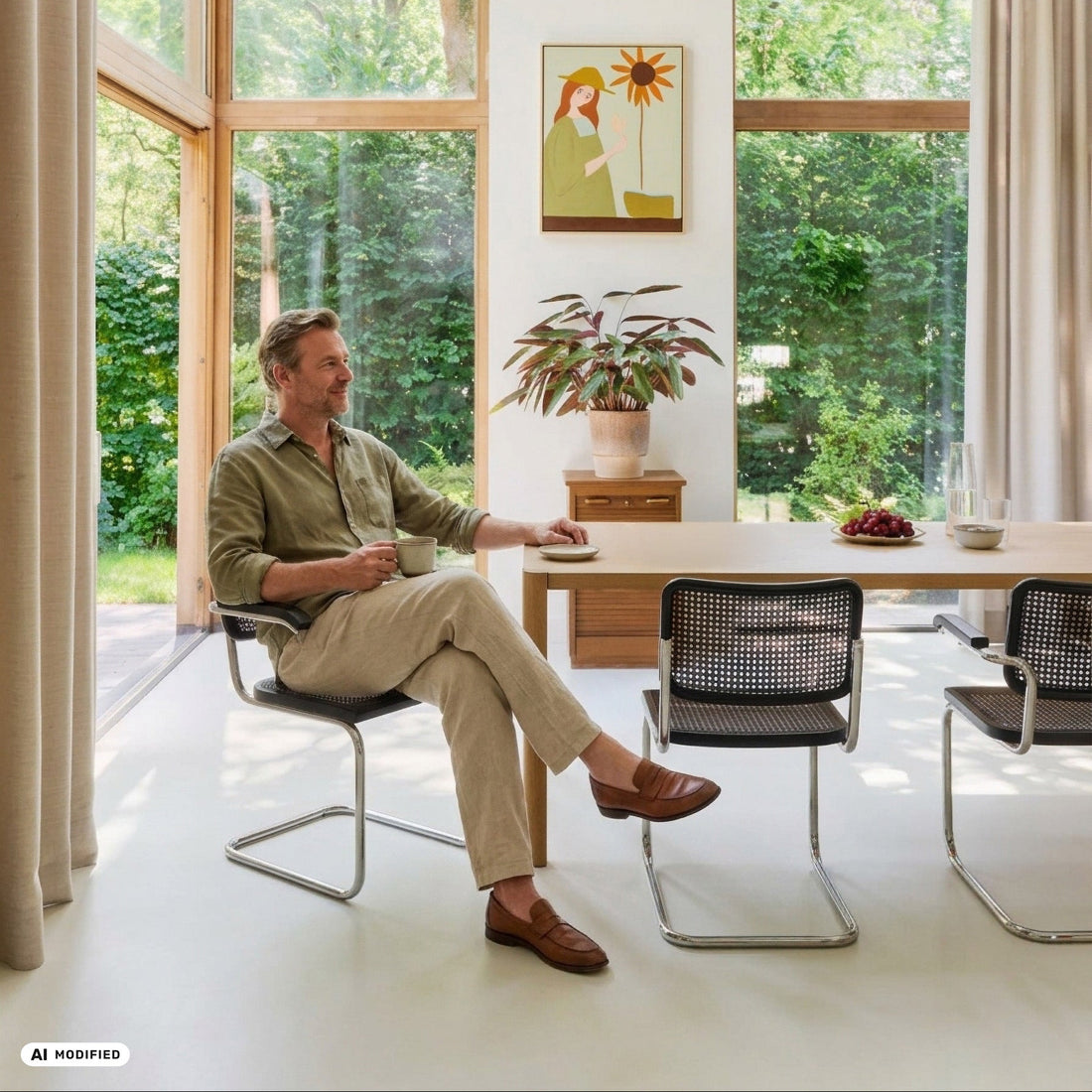
Thonet is one of the world's oldest family-run manufacturers and made design history with its revolutionary production of café furniture. Today, its high-quality furniture remains highly sought after. We spoke to Creative Director Norbert Ruf about Thonet and the brand's sustainability strategy, which has always been part of its corporate philosophy and is based on far more than environmentally responsible production processes.

Mr Ruf, as Creative Director, you are part of the management team at Thonet, one of the world's oldest furniture manufacturers. How did you come to join Thonet? Tell us a little about your career.
How many companies can you say you grew up with, surrounded by their products? When I had the great honour of being asked whether I would like to work with Thonet, of course I said yes. After working at Wilkhahn, Avarte, deSede and Dedon, joining Thonet felt like a step towards the roots of European furniture culture, with the opportunity to weave the company's past together with the present and the future.

Do you experience Thonet as a family business? Is it still possible to have a sense of family spirit in a company of this size and success?
Absolutely. Though I would describe the idea of family a little differently in this context. I think I speak for everyone at Thonet when I say that we feel a strong sense of belonging to the company: we stick together and pursue common goals. The DNA of the Thonet brand lives on in every product and is always part of something greater.
What does a typical day as Creative Director look like? What do you enjoy most, and what is the biggest challenge?
The title "Creative Director" probably sounds more exciting than the job really is. Trade fair visits and conversations with designers are naturally part of the role, but much of it also involves planning, research and project management. It's rewarding to see how targeted measures can move a company forward, and how that change is recognised. I'm also fascinated by the variety of subjects I get to work on. The challenge, especially at Thonet, is to understand the history of a company that is more than 200 years old and use it to shape the future.

With its bentwood and steel furniture, Thonet created milestones in industrial design. These pieces brought the company worldwide renown that continues to this day. Do innovation and the courage to explore new designs still play an important role, or do you continue to focus mainly on the sought-after classics?
The classics form the substance and core of our portfolio. We need to continue to care for them with respect, keeping them relevant through sensitive developments and updates. At the same time, we feel obliged to look ahead, address issues that matter to society today and translate them into new products.
Thonet furniture has long been regarded as particularly durable and sustainable, thanks to its high-quality materials. This has made Thonet a pioneer for many other manufacturers looking to produce sustainable furniture. What makes Thonet's furniture production so sustainable?
Production is only one part of the picture. What matters most is our fundamental attitude to how products should be made. That includes not only how they are manufactured, but also their construction and repairability. As a company, we offer our own repair service, which is very popular.

Thonet products do not need to be replaced after many years of use; at most, they may need a minor repair here and there. In this context, I believe the most important point is that, today as in the past, preventing waste comes before recycling. Our aim is to develop products whose visual and physical quality allows them to accompany us for as long as possible – in other words, products with heirloom quality.
A good example is our Thonet - 214 bentwood chair, for which we have just won the German Sustainability Award. It has been a successful part of our portfolio for more than 150 years. Our company is also certified to DIN ISO 14001. The focus here is on developing and implementing a company-specific, sustainability-oriented management system based on numerous individual standards, which we maintain on an ongoing basis.

For Thonet, sustainability is about more than the environment. People and economic considerations also form part of the "three pillars of sustainability". Could you explain the mission and vision behind this?
The "three-pillar model of sustainable development", as formulated by the German Bundestag's Commission of Inquiry, is based on the idea that genuine sustainable development can only be achieved by pursuing environmental, economic and social goals simultaneously and on an equal footing. We have put this way of thinking and acting into practice as part of Thonet's environmental management system.
The effects of the climate crisis are becoming an ever greater threat to our planet and future generations. Have you developed new approaches to remain economically viable as a company while also becoming climate-neutral? What long-term strategy are you pursuing?
By implementing a multidimensional approach to sustainability that brings together environmental, economic and social considerations, we are safeguarding Thonet's ability to perform in the future and improving continuously.

What new designs can fans of your durable, sustainable furniture look forward to? What can we expect next season?
At Milan Design Week 2021 in Italy, we gave a first preview of our new lounge chair 119, designed by Sebastian Herkner. It is due to be officially launched at imm Cologne, Germany, in January 2022. The Thonet - children's chair S 43 K, a version of Mart Stam's classic cantilever chair for children, is also a welcome addition to our portfolio. It comes in a new colour collection developed with Studio Besau Marguerre, the design duo based in Hamburg in Germany.
And of course, we continued to present new furniture throughout the pandemic. Examples include the versatile Thonet - dining table 1140 by Studio Aisslinger and S 5000 Retreat, Marialaura Rossiello Irvine's development of the S 5000 sofa programme, which can be used to create a "room within a room".

What is your furniture trend for autumn/winter 2022?
Fortunately, the substance of our products means we are somewhat free to avoid chasing every trend. In my view, the new stains we developed with Studio Besau Marguerre for the Thonet - children's chair S 43 K reflect the current preference for more natural colours very well. Inspired by minerals and gemstones, the new shades add touches of colour without being too bright or childish.